日本語


Schisandrol A (also known as Schisandrin or Schizandrin, CAS 7432-28-2) is the principal dibenzocyclooctadiene lignan of Schisandra chinensis fruit. When sourcing Schisandrol A 98%, the single most important verification point is whether the supplier's HPLC method actually separates Schisandrol A from its closely related isomers (Schisandrol B, Schisandrin B and C, gomisin-type lignans) — a generic purity number alone cannot tell you this. Request the batch chromatogram, confirm the main peak identity, and check storage and packaging details before scaling to commercial quantities.
· Schisandrol A = Schisandrin (Schizandrin): one compound, several names — confirm which one your specification means before comparing quotations.
· Schisandra lignans form a family of structurally similar isomers; HPLC methods must resolve them, and "98%" without a chromatogram proves nothing.
· ≥98% HPLC is the common high-purity grade for ingredient development and research use.
· The compound is sensitive to light and moisture over time; cool, dry, light-protected storage protects batch consistency.
· For US-bound supply, confirm the intended use and regulatory pathway with your own regulatory team — documentation requirements depend on the application.
|
Item |
Specification |
|
Product Name |
Schisandrol A (Schisandrin; Schizandrin) |
|
CAS Number |
7432-28-2 |
|
Molecular Formula |
C₂₄H₃₂O₇ |
|
Molecular Weight |
448.51 g/mol |
|
Compound Class |
Dibenzocyclooctadiene lignan |
|
Botanical Source |
Fruit of Schisandra chinensis (Chinese magnolia vine) |
|
Appearance |
White to off-white crystalline powder |
|
Purity |
≥98% (HPLC) |
|
Solubility |
Soluble in methanol, ethanol, DMSO; low solubility in water |
|
Documentation |
COA, HPLC, MS/NMR, SDS, TDS per batch |
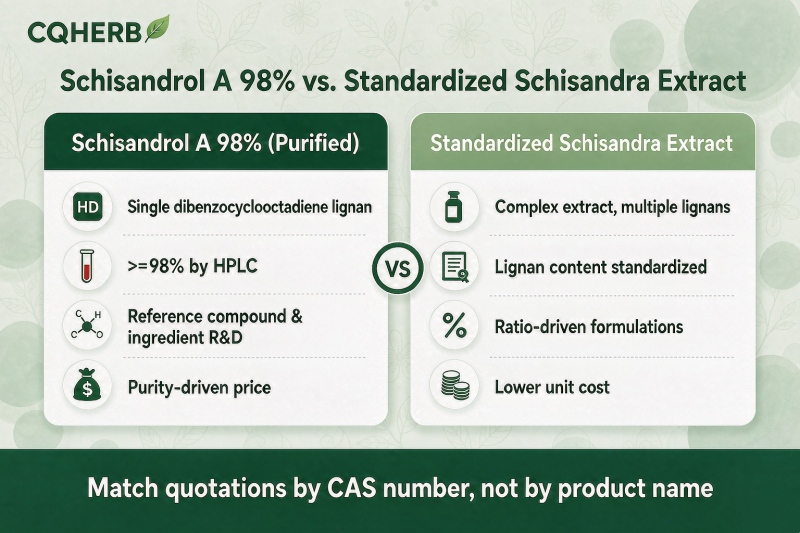
Naming note: suppliers and literature use Schisandrol A, Schisandrin and Schizandrin interchangeably for CAS 7432-28-2. Some catalogs list "Schisandrol B" as a separate compound (a different, more saturated lignan). Because the names look similar, always match quotations by CAS number, not by name alone.
|
Parameter |
Schisandrol A 98% (purified) |
Schisandra extract (standardized) |
|
Composition |
Single lignan compound |
Complex extract with multiple Schisandra lignans |
|
Purity basis |
≥98% Schisandrol A by HPLC |
Total lignans or Schisandrol A content standardized |
|
Typical use |
Ingredient development, analytical reference, research |
Formulations where a defined extract is acceptable |
|
Analytical identity |
Single dominant peak with resolved isomer region |
Multi-peak lignan fingerprint |
|
Price logic |
Purity- and process-driven |
Raw-material- and ratio-driven |
Both product types are legitimate — the procurement risk is buying one while believing you ordered the other. Put the CAS number and the purity basis in your specification sheet before requesting quotations.
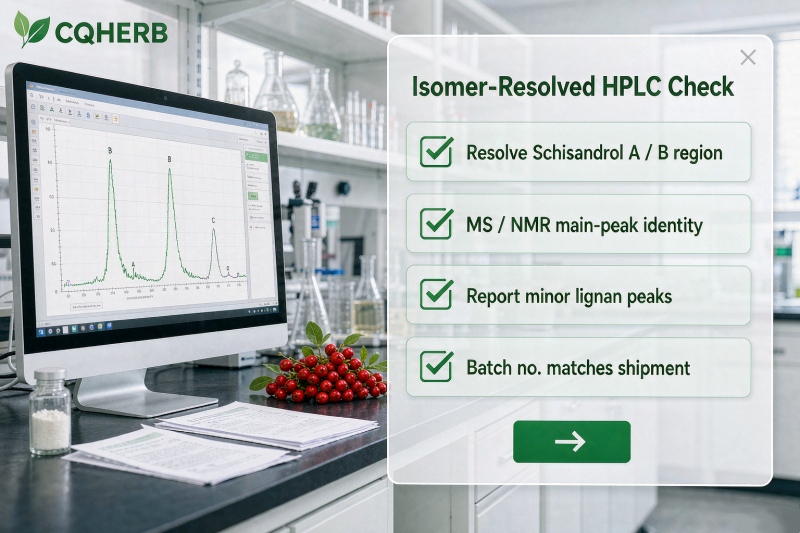
This is where Schisandrol A sourcing differs from most botanical single compounds. Schisandra chinensis contains a family of closely related dibenzocyclooctadiene lignans — Schisandrol A, Schisandrol B, Schisandrin B, Schisandrin C, gomisin A, gomisin N and others — several of which elute close together on typical reversed-phase methods.
When auditing a Schisandrol A 98% batch file:
1. Ask for the full chromatogram, not the purity figure. Check that the isomer region is resolved and that minor lignan peaks are reported.
1. Confirm main-peak identity. MS or NMR data should support that the dominant peak is Schisandrol A (CAS 7432-28-2), not a co-eluting isomer such as Schisandrol B.
1. Method transparency. Column type, mobile phase, wavelength and integration parameters should be stated, so your own lab can reproduce the result.
1. Impurity and residue data. Residual solvents and heavy metals should match the requirements applicable to your market and intended use.
1. Batch traceability. The COA batch number must match the drum labels of the shipment you receive.
A practical sequence used by many procurement teams: order a 20 g sample with full documentation, run independent HPLC (ideally with an isomer-resolution check) at a third-party laboratory, then scale. CQ HERB supports this sample-first model with batch-specific documentation.
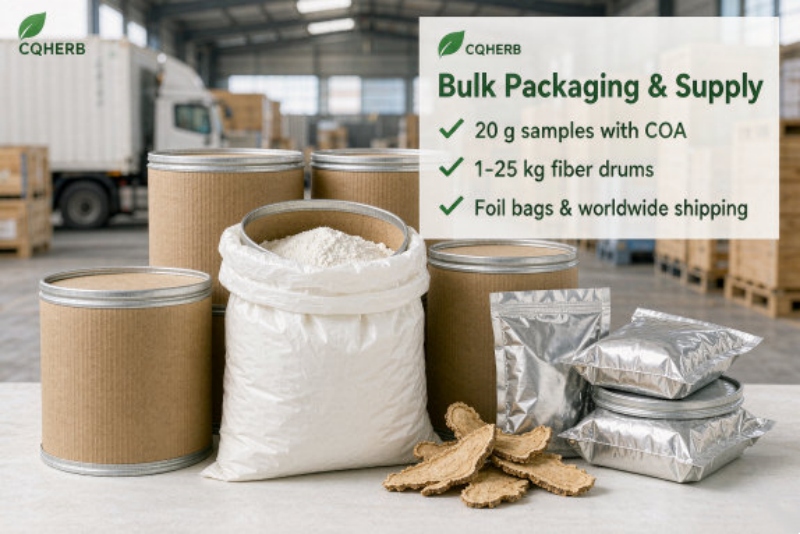
· Light and moisture: lignans gradually degrade under light exposure and humid conditions; containers should be sealed and light-protected.
· Storage: cool and dry, protected from light; follow the SDS/TDS for the specific grade. Research-grade solutions in DMSO are typically stored frozen in aliquots.
· Shelf life: typically 24 months under recommended conditions; check the retest date on the COA.
· Formulation note: low water solubility — ethanol, glycol or DMSO-based premixes are common in development work. Confirm compatibility with your system early.
· Shipping: standard sealed export packaging; for humid climates, confirm desiccant and moisture-barrier arrangements with your supplier.
Schisandrol A 98% is supplied for:
· Ingredient development and research — as a reference compound and botanical-derived active for phytochemistry, analytical method development and natural-product research.
· Formulation development — as a raw material for product development teams working with Schisandra-derived ingredients.
Regulatory note: Schisandra chinensis extracts are familiar to North American and European buyers, but permitted use, labeling and claim language differ by market and application. Confirm the intended use and applicable framework with your regulatory team. CQ HERB supplies the ingredient with technical documentation — it is not a finished product and carries no product claims.
· Full HPLC chromatogram with resolved isomer region
· Main-peak identity confirmed by MS or NMR
· Quotation matched by CAS number, not by product name
· Heavy metals and residual solvents reported
· Botanical source and extraction process described transparently
· COA / SDS / TDS internally consistent
· Sample available for third-party verification
· Moisture-barrier packaging and light-protected storage confirmed
· Multi-batch supply stability and lead-time transparency
Nanjing Spring & Autumn Biological Engineering Co., Ltd. (CQ HERB) supplies Schisandrol A 98% with batch-based documentation including COA, HPLC analytical data, MS/NMR, SDS and TDS, and supports sample evaluation before bulk orders. Our quality management system is certified to ISO 9001.
· Sample stage: 20 g with full documentation for independent verification.
· Development quantities: 100 g–1 kg for pilot work.
· Commercial quantities: multi-kg volumes scheduled against forecast; quoted on request.
· Packaging: double PE bags in fiber drums; foil pouches for small batches; moisture-barrier protection for humid destinations.
· Lead time: confirm current stock and production schedule at quotation.
Q: What is the CAS number of Schisandrol A? A: CAS 7432-28-2. Schisandrol A is also known as Schisandrin or Schizandrin; molecular formula C₂₄H₃₂O₇, MW 448.51 g/mol.
Q: Are Schisandrol A and Schisandrol B the same compound? A: No. They are distinct lignans found in the same plant. Match your specification by CAS number and confirm the HPLC method resolves the isomers.
Q: What purity grade should I buy? A: ≥98% HPLC is the common high-purity grade for ingredient development and research use; standardized Schisandra extracts are a separate product category.
Q: Why is the chromatogram more important than the purity number? A: Because Schisandra lignans are structurally similar, a method that does not resolve the isomer region can overstate the purity of a specific compound. The chromatogram shows what the number hides.
Q: How should Schisandrol A be stored? A: Cool, dry, light-protected, in tightly sealed containers. Refer to the SDS/TDS for batch-specific guidance.
Q: Can I get a sample before a bulk order? A: Yes. CQ HERB provides sample quantities with batch-specific documentation so buyers can complete independent verification first.
Schisandrol A sourcing rewards suppliers who can prove isomer-level analytical control. Match quotations by CAS number, audit the full chromatogram rather than a single purity figure, plan for low water solubility and light-protected storage, and validate the regulatory pathway for your market. A supplier with transparent batch documentation and sample-first evaluation removes most of the risk before the first drum ships.
Related reading: Schisandra chinensis Extracts — Product Category · Natural Active Compounds · Ruscogenin 98% Supplier: CAS 472-11-7 Sourcing Guide
Contact CQ HERB for Schisandrol A 98% specifications, samples, and bulk supply inquiries — Ives Shen, International Sales Dept. · sale05@cqherb.com · www.cqherb.com


 IPv6ネットワークをサポート